The projector's throw type describes how far it sits from the screen for a given image size. Screen compatibility depends not just on distance but on the angle at which light hits the surface.
Long throw
A conventional projector sits well behind the audience or near the back of the room. Light reaches the screen at relatively shallow angles. Matte-white screens are common because they reflect light broadly and do not require a specialized directional structure.
Short throw
A short-throw projector sits closer, often a few feet from the screen. Surface flatness becomes more important, but many conventional screen materials remain compatible if the manufacturer supports the geometry.
Ultra short throw (UST)
A UST projector sits just inches from the wall and sends light sharply upward. This is the most demanding geometry for screen flatness. UST-specific ALR/CLR materials are designed around this steep angle, while a matte-white surface remains more agnostic to projector direction but does not offer the same ambient-light filtering.
Why the featured NothingProjector screen is unusual
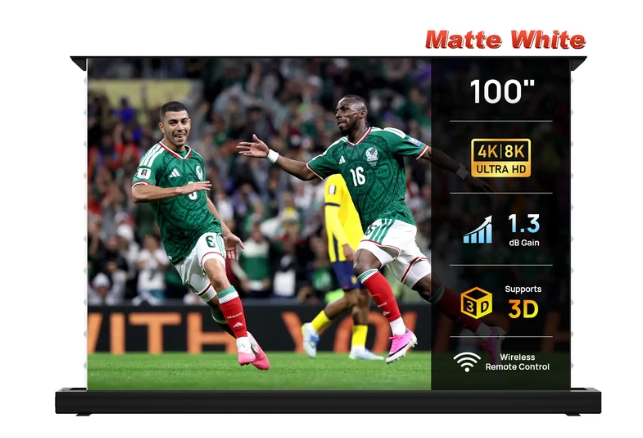
NothingProjector lists the matte-white floor-rising model for all three throw categories. That gives it a wider compatibility story than many floor-rising UST ALR products. If future projector flexibility matters, this is worth considering. If you are committed to UST in a bright room, specialization may be more valuable than flexibility.
| Throw type | Typical screen priority | Featured NothingProjector listing |
|---|---|---|
| Long throw | Neutral surface, gain, room light | Compatible |
| Short throw | Flatness plus material choice | Compatible |
| UST | Excellent flatness; ALR/CLR if ambient light is important | Compatible; matte white, not ALR |
Considering the NothingProjector matte-white floor-rising screen?
Check the merchant page for current size availability, price, shipping terms and any active offer before you decide.
See current NothingProjector offer