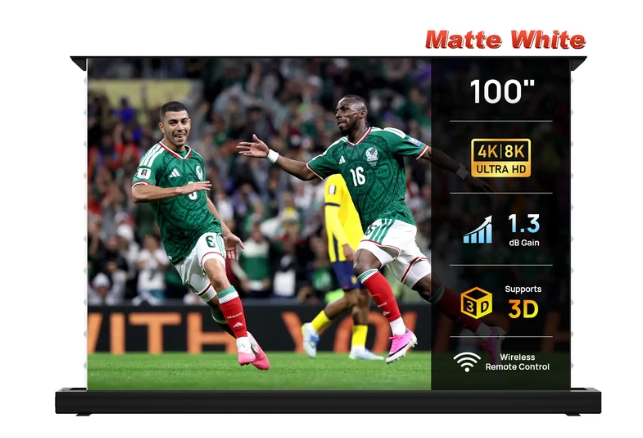
The closest Elite Screens comparison is the Kestrel Tab-Tension 2 CLR: an electric floor-rising screen built around StarBright CLR material for UST projection. Its published 0.6 gain contrasts sharply with NothingProjector's 1.3-gain matte-white approach, which tells you these screens are optimized for different environments.
At-a-glance specifications
| Specification | NothingProjector Matte White | Elite Screens Kestrel Tab-Tension 2 CLR |
|---|---|---|
| Screen type | Motorized floor-rising | Electric floor-rising, tab-tensioned |
| Surface | Matte-white PVC | StarBright CLR® |
| Published gain | 1.3 peak | 0.6 |
| Viewing angle | 170° | 180° listed |
| Projector match | Long / short / UST listed | UST tabletop/bottom-mounted projectors |
| Sizes | 100″ / 120″ | 101″ / 121″ listed for Kestrel Tab-Tension 2 CLR |
| Light rejection | Not an ALR/CLR surface | Elite Screens says StarBright CLR absorbs up to 95% of overhead light |
The biggest difference: optical surface
The NothingProjector screen is matte white and lists 1.3 peak gain. Elite Screens Kestrel Tab-Tension 2 CLR is positioned around a structured ALR/CLR surface for UST projection. That means the comparison is less about brand prestige and more about the physics of your room.
In a dark or well-controlled room, a brighter matte-white surface can make sense. In a room where ceiling light or daylight regularly hits the screen, a purpose-built UST ALR/CLR surface is the category designed to fight that light. See our matte white vs ALR guide for the full tradeoff.
Which setup fits which screen?
| Scenario | NothingProjector | Elite Screens Kestrel Tab-Tension 2 CLR |
|---|---|---|
| Controlled-light theater | Matte white can prioritize brightness and neutral viewing. | CLR benefits are less critical if ambient light is already controlled. |
| Ceiling lights on | No dedicated CLR claim. | StarBright CLR is specifically engineered for overhead-light rejection. |
| Long-/short-throw projector | Listed as compatible. | Kestrel CLR is UST-specific. |
| UST tabletop setup | Compatible, but matte-white. | Purpose-built CLR geometry for this use case. |
| 100/120 class sizes | 100″ and 120″. | 101″ and 121″. |
Projector flexibility
NothingProjector lists long-throw, short-throw and UST compatibility for this matte-white model. That is useful if your projector may change. A UST ALR/CLR surface is more placement-specific because its optical structure is engineered for light arriving from a steep angle.
Motorization and room aesthetics
Both products live in the floor-rising category, so the practical appeal is similar: large-screen projection without a permanent rectangle on the wall. Before buying either, measure case width, furniture depth, projector position, power access and the rise height required to place the image at a comfortable eye line.
How to decide
Do not compare 1.3 vs 0.6 gain in isolation. The Elite screen gives up raw gain to pursue ceiling-light rejection and UST-specific contrast; the NothingProjector screen pursues brightness and projector flexibility. Your lighting conditions determine which design objective matters more.
Considering the NothingProjector matte-white floor-rising screen?
Check the merchant page for current size availability, price, shipping terms and any active offer before you decide.
See current NothingProjector offer