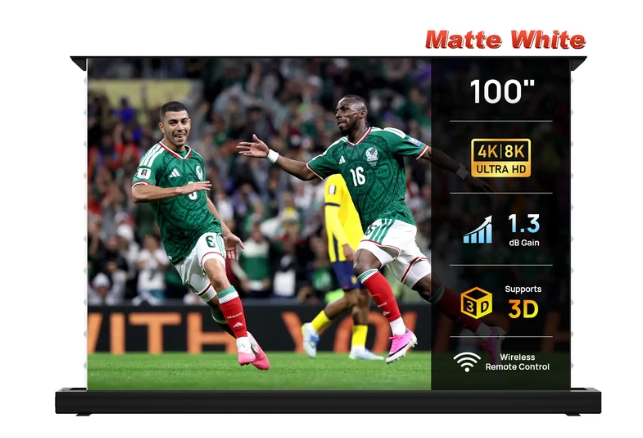
“Worth it” is not a price-only question for a projector screen. The real cost of a bad screen choice is living with the wrong optical surface or an installation that does not fit the room. For this NothingProjector model, four variables should drive the decision: room light, projector type, screen size and how much you value a retractable setup.
Decision 1: Can you control the room lighting?
If curtains, shades and lighting control are part of your viewing routine, matte white becomes easier to justify. The featured NothingProjector surface is listed at 1.3 peak gain and 170° viewing angle, so its design emphasis is brightness and broad viewing rather than ambient-light rejection.
If you want to watch sports or TV with bright overhead lights on, compare a lenticular ALR/CLR screen. The VIVIDSTORM S PRO, Elite Screens Kestrel CLR and WEMAX floor-rising ALR are all more explicitly built around that problem.
Decision 2: Are you committed to one projector type?
The NothingProjector listing says the matte-white model supports long throw, short throw and UST projectors. That flexibility is valuable if you may change projectors later, or if you are not using a UST at all.
By contrast, the ALR/CLR competitors we compare are explicitly UST-focused. If your entire room is designed around a laser TV / UST projector and daylight viewing, that specialization can be an advantage rather than a limitation.
Decision 3: Does a floor-rising screen solve a real room problem?
A floor-rising mechanism earns its cost when the screen needs to disappear. It can preserve windows, wall art, shelving or a clean living-room aesthetic. If a permanent screen is acceptable, compare floor-rising vs fixed-frame screens before paying for motors, scissor supports and automation.
Decision 4: 100″ or 120″?
A 120″ image has substantially more area than a 100″ image, so projector brightness, seating distance and cabinet width all matter. Our 100 vs 120 projector screen guide walks through the practical checks without pretending there is one universal seating-distance rule.
| Situation | NothingProjector matte white | What else to compare |
|---|---|---|
| Dark or dim room | Strong fit on paper; 1.3-gain white surface prioritizes light return. | Fixed-frame matte white if retractability is unnecessary. |
| Bright living room | Possible, but not designed as ALR/CLR. | VIVIDSTORM / Elite / WEMAX UST ALR/CLR. |
| Long-throw projector | Merchant lists compatibility. | A conventional fixed or retractable matte-white screen. |
| UST now, long throw later | Broad compatibility is a useful hedge. | Check whether an optical ALR surface would lock you into UST placement. |
| Need screen to disappear | Floor-rising mechanism directly solves this. | Motorized drop-down if ceiling installation is acceptable. |
When it is worth shortlisting
Shortlist it when you can control ambient light, want a retractable 100″ or 120″ screen, value automation, and either use multiple projector types or want future flexibility. Keep comparing if daytime/ceiling-light performance is the first requirement or if a fixed frame would be perfectly acceptable.
Check the current offer before deciding
Because price and inventory change by region, use the merchant page for the current 100″/120″ options and purchase terms.
See current NothingProjector offer