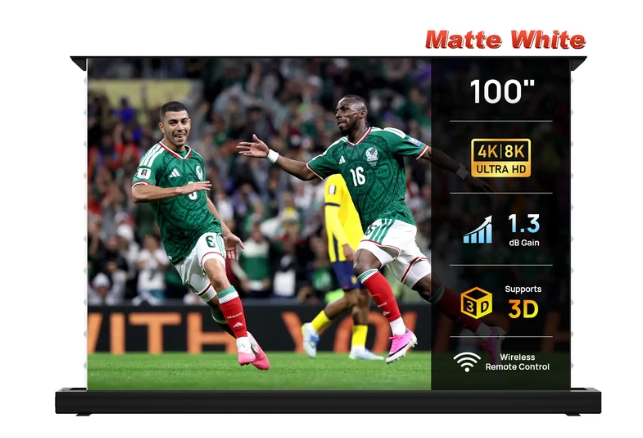
The NothingProjector matte-white screen and VIVIDSTORM S PRO look similar when retracted: both rise from a floor case. Once deployed, they are solving different optical problems. NothingProjector emphasizes a bright 1.3-gain matte-white surface with broad projector compatibility; VIVIDSTORM S PRO is a UST-specific ALR/CLR screen intended to reject ambient and ceiling light.
At-a-glance specifications
| Specification | NothingProjector Matte White | VIVIDSTORM S PRO |
|---|---|---|
| Screen type | Motorized floor-rising | Motorized tension floor-rising |
| Surface | Matte-white PVC | UST ALR/CLR lenticular material |
| Published gain | 1.3 peak gain | Manufacturer listing emphasizes ALR/CLR rather than the 1.3-gain matte-white approach |
| Projector match | Long / short / UST listed | UST laser projector; tabletop/floor placement |
| Sizes | 100″ / 120″ | 72″–130″ options listed on current S PRO page |
| Ambient-light strategy | Diffuse matte-white reflection | Purpose-built ambient/ceiling light rejection |
The biggest difference: optical surface
The NothingProjector screen is matte white and lists 1.3 peak gain. VIVIDSTORM S PRO is positioned around a structured ALR/CLR surface for UST projection. That means the comparison is less about brand prestige and more about the physics of your room.
In a dark or well-controlled room, a brighter matte-white surface can make sense. In a room where ceiling light or daylight regularly hits the screen, a purpose-built UST ALR/CLR surface is the category designed to fight that light. See our matte white vs ALR guide for the full tradeoff.
Which setup fits which screen?
| Scenario | NothingProjector | VIVIDSTORM S PRO |
|---|---|---|
| Dark dedicated room | High-gain matte white is well aligned with this use case. | ALR/CLR can still work, but its light-rejection capability is less necessary. |
| Bright living room | Not designed as an ALR surface. | UST ALR/CLR is explicitly designed for this problem. |
| Long-throw projector | Merchant lists compatibility. | S PRO is marketed for UST placement. |
| Want size below 100″ | Featured model starts at 100″. | Current S PRO listing includes smaller sizes. |
| Might change projector type | Broader listed compatibility. | Optical surface is UST-specialized. |
Projector flexibility
NothingProjector lists long-throw, short-throw and UST compatibility for this matte-white model. That is useful if your projector may change. A UST ALR/CLR surface is more placement-specific because its optical structure is engineered for light arriving from a steep angle.
Motorization and room aesthetics
Both products live in the floor-rising category, so the practical appeal is similar: large-screen projection without a permanent rectangle on the wall. Before buying either, measure case width, furniture depth, projector position, power access and the rise height required to place the image at a comfortable eye line.
How to decide
Choose based on room light and projector geometry. The NothingProjector model is the more flexible screen type on paper because it is listed for long, short and UST projection. VIVIDSTORM S PRO is the more specialized ambient-light solution for a tabletop UST installation. A controlled-light room points toward the matte-white logic; a bright room points toward the UST ALR/CLR logic.
Considering the NothingProjector matte-white floor-rising screen?
Check the merchant page for current size availability, price, shipping terms and any active offer before you decide.
See current NothingProjector offer